Bread-and-Butter ETFs in Volatile Markets

Authors & Contributors

Theodore Bair Jr., CFA

David Culp
How do simple core ETFs hold up compared to more complex strategies during periods of volatility?
When market uncertainty rises, there is typically greater interest in complex ETFs strategies, such as those that use leverage, single-stock exposure, or options. The pitch is compelling, with expectations of outsized gains, precision hedges, and tactical agility. Yet the reality is that these vehicles can amplify losses, deviate from intended exposures, and underperform simple benchmarks during turbulent periods. The reasons are structural and behavioral, and they compound when investors most want predictability.
Risk Landscape of Complex ETFs
- Volatility decay: Leveraged and inverse ETFs are calibrated for single-day objectives. Over multiple days, compounding can produce returns that diverge from the target—especially in whipsaw markets.
- Rebalancing and transaction costs: As the underlying baskets or derivatives require adjustment, turnover and friction rise, creating drag relative to benchmarks.
- Structural risks: Swaps and options add a layer of complexity to exposure management; in fast markets, mismatches and execution timing can widen tracking errors.
- Behavioral risk: Performance chasing and misunderstanding daily reset mechanics lead to poor investor outcomes, particularly when macro uncertainty elevates stress.
- Concentration risk: Single-stock or niche ETFs magnify company or sector shocks, which is counterproductive during periods of heightened risk.
The Case for “Bread-and-Butter” ETFs
Against this backdrop, the case for broad-market ETFs is straightforward. These mainstream sector, style and market-cap weighted exposures are built to deliver the market they track without the structural drift that comes from complex strategies. Their potential advantage in volatile periods stems from structural simplicity, cost discipline, and portfolio diversification.
- Simplicity and transparency: Straightforward construction makes investment behavior easier to understand and predict, which is an anchor when markets are moving fast.
- Lower cost and tighter tracking: Reduced reliance on derivatives and lower turnover translate to tighter tracking versus benchmarks and decrease the total cost of ownership.
- Portfolio resilience: Broad diversification mitigates market shocks and reduces the need for tactical investing.
- Potential fit for long-term goals: Compounding of market returns—without the worry of leverage-induced disruptions, supports disciplined investing over time.
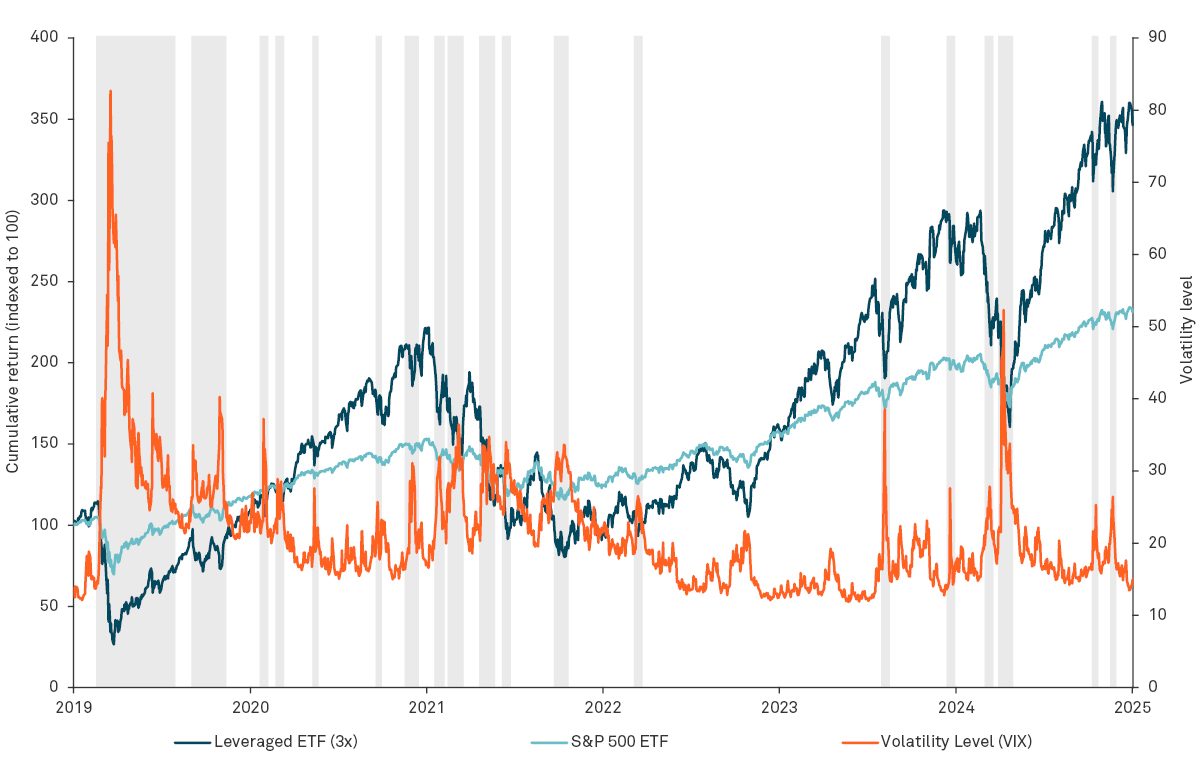
The data below illustrates how broad S&P 500® exposure maintains more predictable compounding and shallower drawdowns versus leveraged exposure, particularly when volatility rises.
S&P 500 ETF versus Leveraged ETF with Volatility Overlay
Implications for Portfolio Construction
Investors may benefit when they spend less effort on timing complex exposures and more effort on calibrating simple, reliable beta exposures1 . Bread-and-butter ETFs—low-cost index funds with broad, diversified market exposure—provide predictable building blocks for core allocations, risk budgeting, and rebalancing, so decisions remain anchored to objectives rather than headlines.
Why BNY’s ETF Capabilities Align with “Bread-and-Butter” Investing
BNY’s strengths in ETFs and index equity strategies are purpose-built for investors when volatility rises. While complex products can have specialized roles, the backbone of most portfolios is simple, transparent exposure with tight tracking and operational resilience. BNY’s capabilities support that backbone:
- Index equity and discipline: Clear methodology, consistent implementation and tracking discipline support the predictability broad-market investors seek.
- Liquidity and execution support: Deep market connectivity and trading support help minimize slippage and spreads—especially valuable when volatility elevates dispersion.
- Operational resilience and risk controls: Strong infrastructure, robust governance and defined controls help maintain tracking and mitigate operational risks during fast markets.
- Cost efficiency: Streamlined processes help keep total costs low and tracking tight.
- Breadth and simplicity: A range of straightforward exposures across marketcap segments, sectors and styles provides diversified core building blocks without structural complexity.
As products become more complex and nuanced, innovation and behavioral risks become heightened. Bread-and-butter ETFs remain a reliable path to achieving intended exposures. They promote discipline through simplicity, reduce the need for timing, and allow long-term compounding to work as designed. BNY’s ETF capabilities align directly with this approach: helping investors access the market cleanly, track targets tightly, and stay focused on goals.
1Beta exposure is the portion of a portfolio designed to capture broad, market‑wide returns (systematic risk) in a predictable way so investors can calibrate overall risk level rather than attempt to time complex, transient market moves.
PAST PERFORMANCE IS NOT NECESSARILY INDICATIVE OF FUTURE RESULTS.
All investments involve risk, including the possible loss of principal. Certain investments have specific or unique risks. No investment strategy or risk management technique can guarantee returns or eliminate risk in any market environment.
This material has been provided for informational purposes only and should not be construed as investment advice or a recommendation of any particular investment product, strategy, investment manager or account arrangement, and should not serve as a primary basis for investment decisions. Prospective investors should consult a legal, tax or financial professional in order to determine whether any investment product, strategy or service is appropriate for their particular circumstances. This document may not be used for the purpose of an offer or solicitation in any jurisdiction or in any circumstances in which such offer or solicitation is unlawful or not authorized. Views expressed are those of the author stated and do not reflect views of other managers or the firm overall. Views are current as of the date of this publication and subject to change. This information may contain projections or other forward-looking statements regarding future events, targets or expectations, and is only current as of the date indicated. There is no assurance that such events or expectations will be achieved, and actual results may be significantly different from that shown here. The information is based on current market conditions, which will fluctuate and may be superseded by subsequent market events or for other reasons. References to specific securities, asset classes and financial markets are for illustrative purposes only and are not intended to be, and should not be, interpreted as recommendations. Charts are provided for illustrative purposes and are not indicative of the past or future performance of any BNY Mellon product. Some information contained herein has been obtained from third party sources that are believed to be reliable, but the information has not been independently verified. No part of this material may be reproduced in any form, or referred to in any other publication, without express written permission.
Indices referred to herein are used for comparative and informational purposes only and have been selected because they are generally considered to be representative of certain markets. Comparisons to indices as benchmarks have limitations because indices have volatility and other material characteristics that may differ from the portfolio, investment or hedge to which they are compared. The providers of the indices referred to herein are not affiliated with Mellon Investments Corporation (MIC), do not endorse, sponsor, sell or promote the investment strategies or products mentioned herein and they make no representation regarding the advisability of investing in the products and strategies described herein. Investors cannot invest directly in an index.